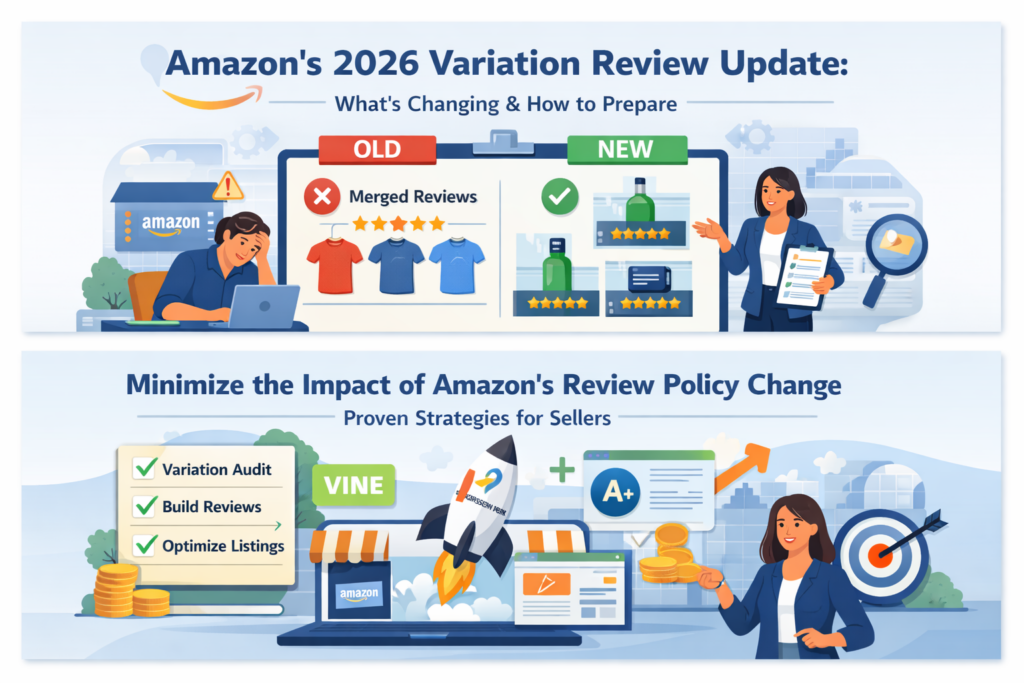
Amazon’s 2026 Variation Review Update: What It Means for Sellers?

Amazon 2026 Variation Review Update

Amazon has announced a significant change to how product reviews are shared across variations, rolling out between February 12 and May 31, 2026. At first glance, this update may sound unsettling; especially for brands that rely heavily on shared reviews to drive conversions.

But when you look deeper, this is less about penalizing sellers and more about improving trust, accuracy, and long-term marketplace health.

In this article, we’ll explain:

  • What exactly is changing
  • The possible positive and negative impact on businesses
  • Whether sellers should actually worry
  • A practical, step-by-step plan of action
  • How Conversion Perk helps brands navigate this shift smoothly

Until now, Amazon allowed reviews to be shared across all variations within a parent listing; even when variations had meaningful differences in features, performance, or use cases.

This meant:

  • A strong “hero” variation could carry weaker ones
  • Reviews sometimes didn’t match the exact product a customer was viewing

Starting February 12, 2026, Amazon will restrict review sharing only to variations that differ in minor, non-functional ways.

Reviews will continue to be shared for:

  • Color or pattern variations
  • Size variations with the same function (e.g., queen vs king bedding)
  • Pack size or quantity differences
  • Secondary scent differences for non-scent-focused products
  • Different fitments of the same product type (e.g., phone cases for different models)

Reviews will no longer be shared when:

  • Functionality changes
  • Materials, performance, strength, capacity, or core features differ

Amazon is rolling this out gradually by category and will notify sellers 30 days in advance before any listings are affected.

At its core, this update is about review accuracy and customer trust.

From Amazon’s perspective:

  • Customers rely heavily on reviews to make decisions
  • Misleading or irrelevant reviews increase dissatisfaction and returns
  • Returns and poor experiences hurt Amazon’s long-term economics

This update aligns with Amazon’s broader direction over the past few years:

  • Stricter listing quality enforcement
  • Crackdowns on variation abuse
  • Greater emphasis on customer experience over seller shortcuts

In simple terms: Amazon wants reviews to reflect the exact product being purchased.

Short-Term Challenges Sellers May Face


Let’s be honest—there will be some short-term disruption.

  1. Lower visible review counts on some variations Child ASINs that previously benefited from shared reviews may suddenly show fewer reviews or lower ratings.
  2. Conversion rate pressure Shoppers often use review volume as a trust signal. A sudden drop can affect conversion, especially on newer or lower-traffic variants.
  3. Advertising efficiency fluctuations Sponsored Products for low-review ASINs may see lower CVR and higher CPC until trust signals rebuild.
  4. More operational effort Managing review growth and performance at the child-ASIN level requires more structure and attention.

Long-Term Benefits Many Sellers Overlook


Despite the short-term pain, this change brings meaningful upside:

  1. More accurate reviews = higher buyer trust Customers see feedback that actually applies to the product they’re buying.
  2. Fewer negative reviews caused by mismatch One poor variation can no longer drag down others unfairly.
  3. Reduced return rates When expectations match reality, returns naturally decline.
  4. Cleaner performance data You can finally see which variations are truly strong—and which need improvement.

For brands thinking long-term, this is actually a healthier marketplace dynamic.

Concerned? Yes. Panicked? No.

This update does not mean:

  • Your business is at risk overnight
  • Amazon is “punishing” sellers
  • Shared reviews are disappearing entirely

What it does mean is that:

  • Poor variation structure will no longer be protected
  • Review relevance will matter more than review volume
  • Sellers who prepare early will be far less affected

Brands that act proactively will experience controlled impact, while those who wait may face sudden drops with little time to react.

Here’s how we recommend approaching this strategically:

Step 1: Audit Your Variation Structure (Before Amazon Forces It): As the first step, you

should review your catalog and ask:

  • Do these variations truly represent the same product?
  • Would a customer expect these products to share reviews?

If functionality differs, separate the variations now—on your terms, not Amazon’s.

Step 2: Use the Correct Variation Themes: Many sellers are forcefully creating variations to take advantage of reviews so Amazon specifically advises sellers to ensure that variation themes reflect actual differences:

  • Use color for color differences
  • Use size for functional sizing
  • Avoid misusing quantity or style to group dissimilar products

Correct themes increase the chance that eligible review sharing continues.

Step 3: Strengthen Review Generation for Individual ASINs: After this update, reviews will become more ASIN-specific:

  • Enroll eligible products in Amazon Vine
  • Use compliant post-purchase review requests
  • Drive targeted traffic to specific child ASINs
  • Prioritize early review velocity after any split

Even a modest number of high-quality reviews can stabilize conversion.

Step 4: Improve Product Pages to Reduce Review Dependence: When review counts are lower, listing quality matters more. So you need to make sure your listings are up to date with all latest information and answering all questions a customer might have.

Focus on:

  • Clear, benefit-led bullet points
  • Strong visuals and lifestyle images
  • A+ Content explaining use cases and differences
  • Comparison charts that guide the buyer confidently

Step 5: Adjust Advertising Strategically

  • Temporarily reduce spend on newly split, low-review ASINs
  • Shift budget toward brand terms and best-reviewed products
  • Use Sponsored Brands and Stores to guide shoppers intentionally

How Conversion Perk Helps Brands Navigate This Change

At Conversion Perk, we view this update not as a threat—but as a moment for brands to build stronger, more sustainable Amazon foundations.

Here’s how we help:

  • Variation & Catalog Audits: We identify high-risk variation structures and recommend clean, compliant setups that protect performance.
  • Review & Trust Signal Strategy: From Vine enrollment to review velocity planning, we help rebuild social proof where it matters most.
  • Conversion-Focused Listing Optimization: We optimize PDPs to convert even when review counts are lower—through messaging, visuals, and A+ Content.
  • Amazon Ads Realignment: We rebalance ad spend to minimize wasted budget and protect profitability during the transition.

Most importantly, we help brands stay ahead of platform changes rather than react to them.

Amazon’s variation review update is a clear signal: Accuracy and trust now matter more than inflated social proof.


Yes, there may be short-term adjustments; but sellers who prepare early will:

  • Protect conversions
  • Reduce returns
  • Gain cleaner performance insights
  • Build stronger long-term brands

And with the right strategy and support, this transition doesn’t have to be disruptive at all. If you’d like help auditing your catalog or preparing a transition plan, Conversion Perk is here to help; every step of the way.
author avatar
Devjeet